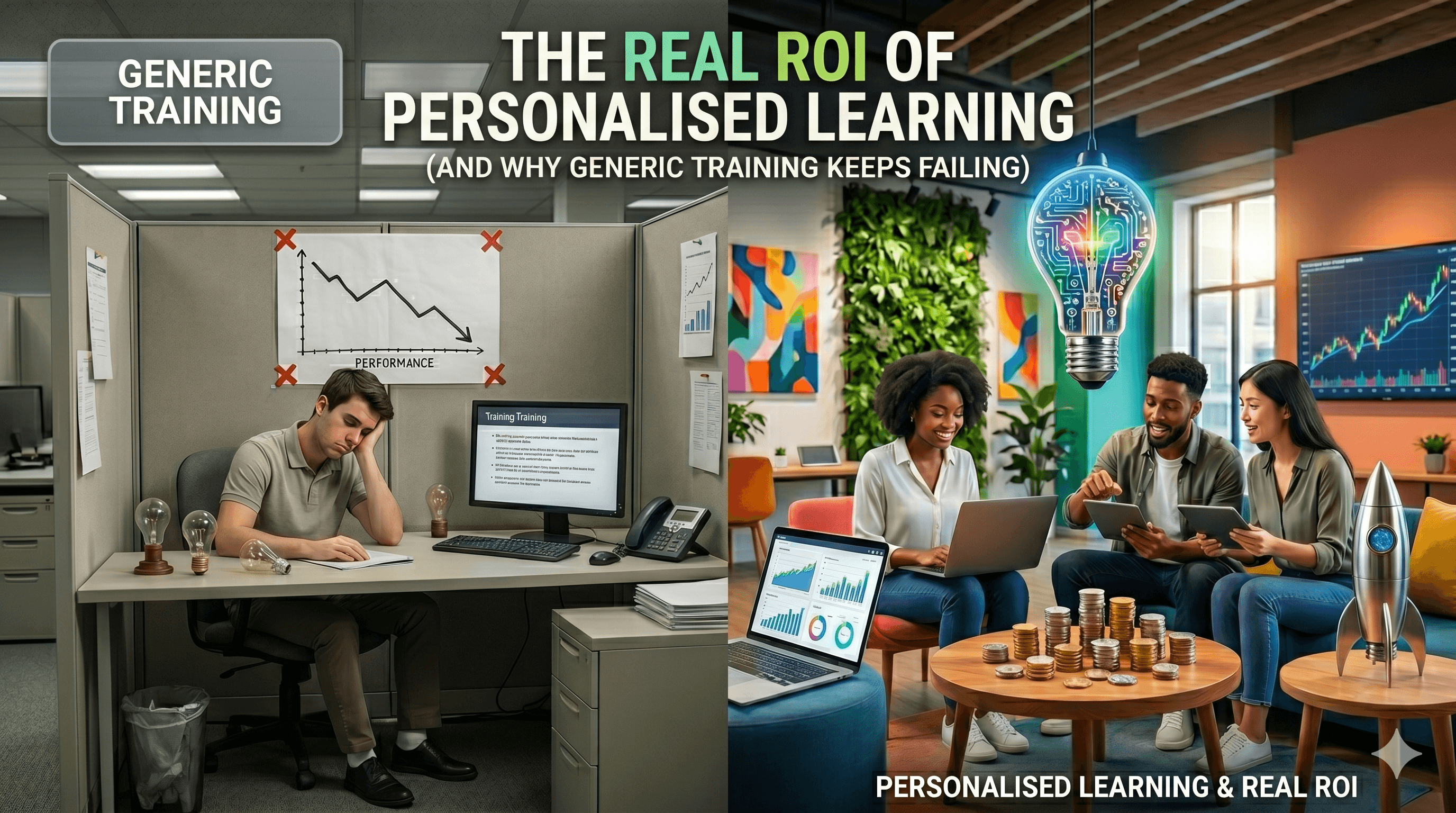
The Real ROI of Personalised Learning (And Why Generic Training Keeps Failing)
Most corporate training programs have a dirty secret: nobody finishes them.
Industry benchmarks put average LMS course completion at 20–30%. Knowledge retention 30 days later? Closer to 10%. And yet L&D budgets keep climbing whilst global corporate training spend crossed $400B last year.
That's not a budget problem. That's a delivery problem.
The math behind one-size-fits-all training
When you push the same 40-minute compliance module, the same onboarding curriculum, or the same "Intro to AI" course to every employee, you're paying for three things at once:
The content (cheap)
The seat time (expensive - that's salary you're burning)
The opportunity cost of the wrong learner getting the wrong depth
A senior engineer doesn't need the same AI primer as a marketing coordinator. A high-performing sales rep doesn't need to re-watch the objection-handling module they already aced. Generic training taxes your best people and underserves your newest ones.
What personalised learning actually changes
When learning adapts to the individual: their role, prior knowledge, pace, and gaps, the numbers move fast:
Completion rates jump from ~25% to 70–90%. Learners stay engaged when content meets them where they are.
Time-to-competency drops 40–60%. No more sitting through what you already know.
Retention roughly doubles versus passive video courses, because adaptive systems force active recall.
Manager hours saved. L&D teams stop chasing completions and start measuring outcomes.
Stack those gains against a 500-person org spending $1,500/employee/year on training, and personalised delivery typically pays for itself inside one quarter before you count the productivity lift from people actually learning the thing.
Why this is finally possible
For 20 years, "personalized learning" meant branching scenarios - a designer hand-built three paths and called it adaptive. That was theater.
AI tutors changed the economics. A single platform can now:
Ask the learner what their organisation and role is, and adapt accordingly
Generate practice tailored to their exact work context
Adjust difficulty in real time
Give tailored feedback based on their actual responses
What used to require a 1:1 human coach is now available to every employee, on demand, at a fraction of the cost.
The L&D leaders pulling ahead in 2026
The L&D heads who are winning right now share three habits:
They measure outcomes, not seat time. Completion is vanity; capability is sanity.
They pilot small, fast. One team, one skill, 30 days, before any enterprise rollout.
They treat AI tutors as infrastructure, either replacing static courseware or enhancing existing content with personalised practice.
If your dashboard still leads with "courses completed," you're optimizing the wrong metric.
Where GenLearn fits
GenLearn is the adaptive learning layer Corporate L&D teams use to replace generic courseware with AI tutors that personalised practice for every skill you're trying to build. Teams running GenLearn see completion rates above 70%, time-to-competency cut roughly in half, and, for the first time, data on learner engagement and thinking that goes well beyond completion rates.
If your training spend isn't translating into measurable capability, you don't need more content. You need a different delivery model.
See it on your own use case. Click below to book a 30-minute GenLearn demo.
We'll show you exactly what personalized learning looks like for your team, and the ROI math for your headcount.