Personalisation vs Segmentation: The Distinction Most LMS Vendors Don't Want You to Notice
Vincent Mateljan
Most 'personalized learning' is just segmentation in a better wrapper. Here's the difference, why it matters, and how to tell which one your LMS actually delivers.
Pull up the last three LMS or learning platform proposals on your desk. I'd bet good money that every one of them uses the word "personalised" at least twice on the front page.
Now ask yourself, honestly: which of those platforms actually responds to an individual learner? Not "shows them a different module than their peer in another department." Not "skips the slide they've already passed a quiz on." Actually responds to what that specific person just said, struggled with, or got wrong.
If you can't think of one, you're not alone. The L&D industry has spent the better part of a decade calling something "personalisation" that is, on inspection, just segmentation in a better wrapper. The two are not the same thing. And the gap between them is becoming the most important strategic question in corporate learning right now.
This post is about that distinction, what it is, why it persisted, how to tell which one you actually bought, and what changes when you get the real thing.
The Bait and Switch
Here is the move, simplified.
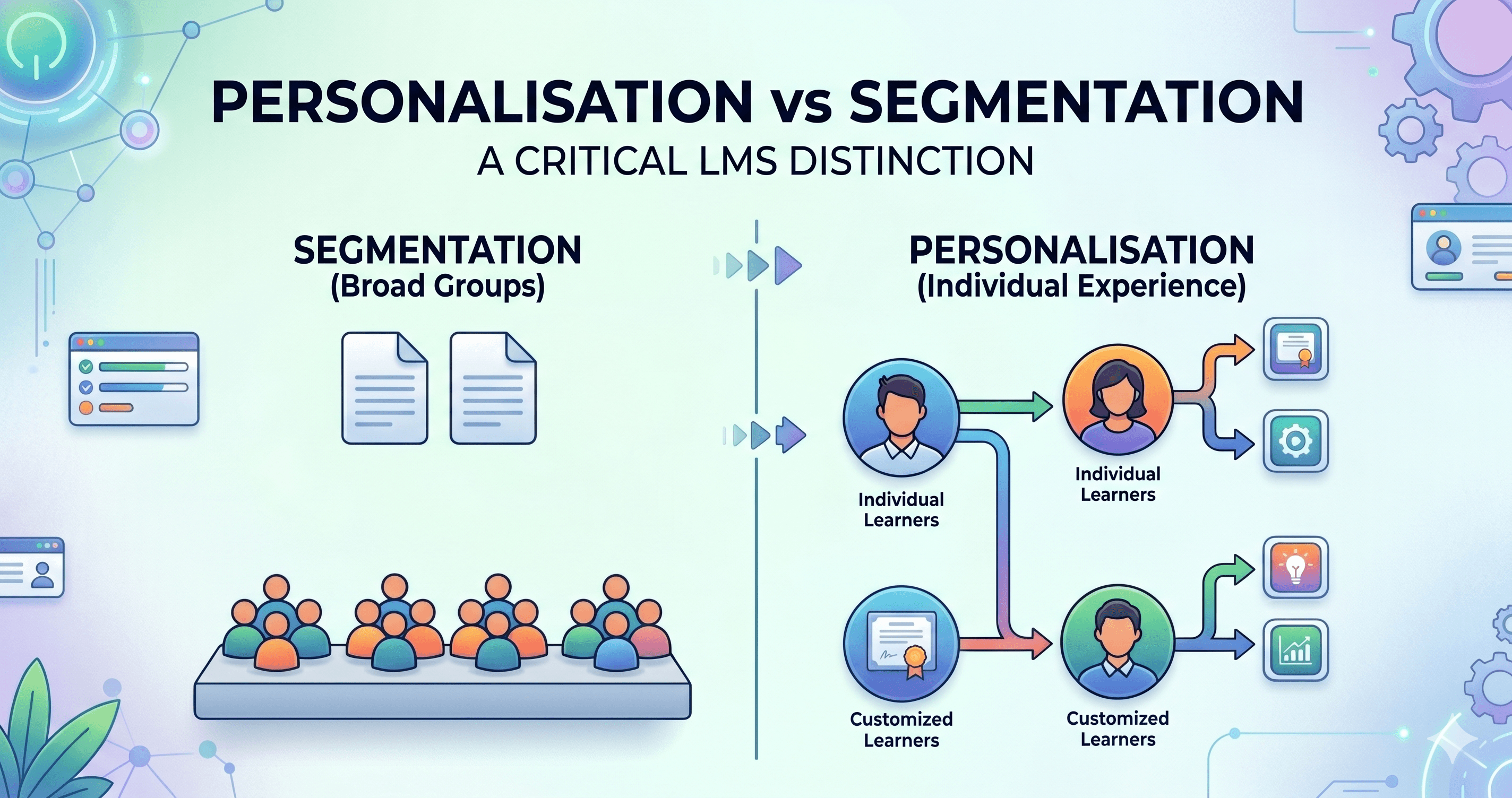
A vendor builds a system that can sort learners by attribute - role, level, department, tenure, location, business unit, results on a baseline quiz, and then serve different content modules to each bucket. A new manager gets one curriculum. A tenured manager gets a different one. A sales rep gets one compliance set, a sales rep in a different department gets another. The system makes a routing decision based on who you are, and then delivers fixed content to the bucket you fell into.
This is segmentation. It is what your marketing team does to email lists. It is a useful and entirely legitimate capability, and it has been around in some form since the first SCORM-compliant LMS shipped in the early 2000s.
The slight of hand is that the industry started calling this personalisation, because "personalisation" tested better in buyer surveys, sounded more sophisticated, and let vendors charge more for what was, underneath, the same routing engine they'd been shipping for years.
The real definition of personalisation, the one your buyers and learners intuit even if they don't articulate it, is different. Personalisation means the experience adapts to the individual, in something resembling real time, based on what they specifically do, say, ask, or fail at. A learner asks a clarifying question and gets an answer addressed to their question, not to the average question someone in their bucket would have asked. A learner gives a weak answer in a role-play and gets feedback on their answer, not a generic playback of the model response.
Segmentation routes you to content. Personalisation responds to you. They are different categories.
Why the Industry Could Get Away With This
It's worth being fair to the vendors who built segmentation-as-personalisation, because they didn't do it out of malice. They did it because, until very recently, real personalisation at scale was technically and economically impossible.
To respond to an individual learner in real time, you need three things: the ability to interpret what the learner just said or did (not just record their click), the ability to generate a relevant response (not just look one up), and the ability to do this for tens of thousands of learners simultaneously without breaking your unit economics. Until large language models matured into something deployable, that combination didn't exist outside of a one-on-one tutor - which is the historical proof point that personalisation works, and the historical reason it never scaled.
So vendors did what vendors do. They shipped the closest approximation the technology allowed, segmentation, and called it by the word the market wanted. That was a defensible move in 2015. In 2026, it is no longer appropriate language for any L&D leader who has noticed that the technology constraint has lifted.
The Diagnostic
If you want to know whether your current platform delivers personalisation or segmentation, here are the questions that cut through the marketing copy.
Does the experience change when the learner gives a wrong or weak answer in their own words, and not from a multiple-choice list? If the platform can only respond to a fixed set of inputs you pre-defined, it's segmentation. If it can respond to whatever the learner actually wrote or said, that's personalisation.
Does feedback to the learner reference what they specifically did - quoting back their language, naming the specific gap - or is it a generic "great job" / "review this section" message? Specificity is the tell. Personalisation is specific because it has to be, by definition.
If you put two learners in the same bucket through the same module, do they end up with measurably different experiences? Two people in the "new manager" segment should, if real personalisation is happening, leave the same module having done different things, because they brought different gaps to it. If they leave with identical experiences, you have segmentation.
Can the platform handle a question or scenario the content authors didn't anticipate? Segmentation systems fail at the edges of the script. Personalisation systems are designed to handle the edges, because the edges are where the learner is.
Most platforms, run honestly through these four questions, fail at least three.
What Real Personalisation Requires
The core of real personalisation is responsiveness - the platform's ability to attend to the learner in the moment.
That word, attention, is the one that's been missing from L&D conversations and is, I think, the most important word in the room right now. The deepest insight from the last decade of learning science isn't that adults learn best when content is "engaging" or "interactive" or "gamified." It's that adults learn best when they feel attended to, when the experience is shaped, even slightly, by who they are and what they just did.
This is why one-on-one human tutoring is the most effective form of learning that has ever been measured, and why nothing else has come close. The tutor doesn't have magic content. The tutor has attention.
Most corporate L&D is the inverse of this. It is one-to-many, broadcast, asynchronous, and structurally incapable of attending to anyone. The result is a learning experience that adults rationally tune out, because nothing about it suggests their participation is being noticed.
When AI-led conversational learning is done well, what it actually delivers is not "AI." It is the first scalable approximation of attention that corporate learning has ever had. The learner says something, and something responds to what they said. That is the entire mechanism. The technology is almost beside the point.
This is also why segmentation-marketed-as-personalization felt hollow even when buyers couldn't quite name why. Segmentation routes you. It does not attend to you. Learners can tell the difference, even if procurement can't.
The Quiet Implication for L&D Leaders
If you accept the above, that segmentation and personalisation are different categories, and that real personalisation is now buildable, three things follow.
First, your existing learning stack is probably not what your vendor says it is. This is not a moral failing on anyone's part. It is a vocabulary problem the industry created and is reluctant to fix. But it does mean that when you cite "personalisation" as a current capability in your strategy deck, you should probably check whether you mean segmentation.
Second, the buying decisions you make in the next eighteen months will likely lock in your organisation's learning experience for the next five years. The vendors who shipped segmentation-as-personalisation are now scrambling to add a conversational layer on top of their existing routing engines. The vendors who built personalisation from the ground up are a different category of platform. Both will use the same words in their proposals. You will have to read past the words.
Third, and most strategically: when real personalisation becomes table stakes in corporate learning, and it will, the buyers who have already built the muscle for it will be ahead. The buyers who are still defending segmentation as "good enough" will be having an awkward conversation with their CEO about why the company spent seven figures on a learning platform that, on inspection, doesn't actually attend to anyone.
What to Ask Vendors This Quarter
The simplest test is the most useful one.
In your next vendor evaluation, ask the seller to put you, personally, into a live module on their platform. Don't accept a recorded demo. Ask to be a learner for ten minutes. Then deliberately give a wrong answer in your own words, something off-script, something the content authors couldn't have predicted, and see what the platform does.
If you'd like to run that test againusing conversational learning, we run 30-minute live evaluations where the only thing we ask is that you bring an off-script answer and try to break the conversation.
The technology has moved. The vocabulary hasn't. The job of L&D leaders this year is to notice the gap before their vendors close it themselves.