Compliance Training Has a Practice Problem (And It's Costing You More Than You Think)
Vincent Mateljan
Completion rates measure attendance, not competency. Here's why compliance training keeps failing in the moments that matter - and what to do about it.
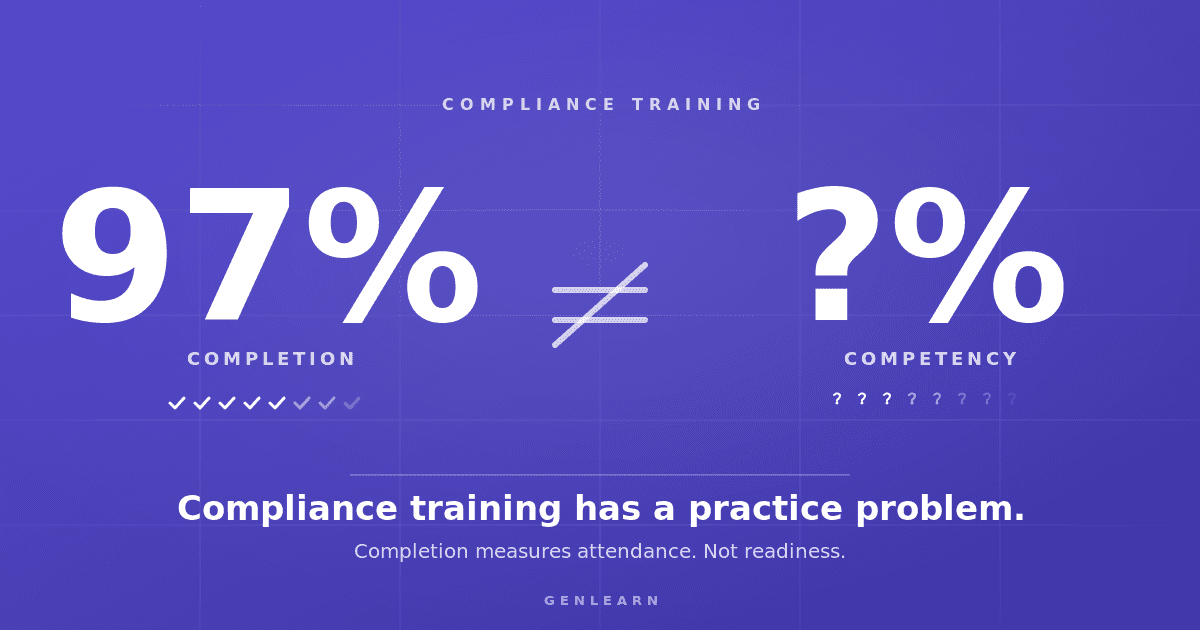
Your compliance training has a 97% completion rate. Your harassment claims are flat or rising. Your data-handling incidents haven't dropped. Your support line still rings off the hook.
All of those things can be true at the same time. And if you've been in L&D for more than a year or two, you already know they often are.
This is the open secret in corporate compliance training: the metric we report up to the board, completion, measures attendance and not competency. We've built a multi-billion-dollar industry around proving people sat through content, and then we act surprised when content alone doesn't change what they do in a tense conversation with a direct report, a vendor offering a "gift," or a colleague making a comment they shouldn't.
The problem isn't that your people are bad at compliance. The problem is that we've never actually trained them in it. We've informed them.
The Completion Illusion
Walk into any L&D function and you'll see the same dashboard: modules assigned, modules completed, completion rate above 90%, certificates issued. That's the artifact of training. But it's not training.
Compliance content tends to follow a predictable rhythm. A video plays. A scenario is described. A multiple-choice question appears. The learner picks A, B, C, or D, and because the right answer is usually obvious in the context of the question, they get it correct, click forward, and the module marks them "competent."
Now ask yourself what that learner is supposed to do six months later when a peer makes an off-colour comment in a Teams channel. Or when a procurement team member is offered World Cup tickets by a supplier they're about to sign. Or when a junior engineer is asked by a senior to bypass a data-handling step "just this once."
The skill required in those moments isn't recall. It's judgment under pressure. And judgment isn't built by watching someone else demonstrate it on a screen. Judgment is built through reps.
We know this is true in every other domain. We don't certify pilots by quizzing them on aerodynamics. We don't licence surgeons because they watched a video about appendectomies. We don't hire salespeople based on their ability to recite a methodology. In every field where the stakes are real, the standard is practice with feedback until performance is reliable.
Except in compliance, where the stakes are arguably highest, and where we've decided that a 12-minute video and a four-question quiz is enough.
Why Content-Only Training Fails the Compliance Job
There's a specific reason compliance topics resist content-only training.
Compliance is almost never about knowing the rule. Most employees, when asked plainly, will tell you that harassment is wrong, bribery is illegal, customer data shouldn't be exported to a personal device, and discriminatory hiring practices are prohibited. The rule isn't the gap.
The gap is the application of the rule in a moment of social or commercial pressure, when the right answer competes with a wrong answer that has its own logic - "don't make a fuss," "they meant it as a joke," "we'll lose the deal," "everyone does it."
That gap doesn't close with more content. It closes when an employee has rehearsed the moment, said the words in response to the pressure, felt the awkwardness, and received feedback on whether their response actually achieved what it needed to achieve, and tried again. That's the missing rep.
For decades, the only way to deliver that rep was a facilitator-led role-play workshop. Which works well, and also doesn't scale. You can't put 12,000 employees through facilitated role-play every year. So we stopped trying, and we replaced practice with content, and we measured what was easy to measure.
What "Practice" Actually Means in Compliance
It's worth being concrete about what practice looks like, because the word gets used loosely.
A new people manager is approached by a team member who discloses a mental health condition and asks for accommodations. Practice means: that manager has, before the real moment, had a conversation where they had to respond to a learner playing the team member. They've had a coach (human or AI) tell them when their phrasing strayed into territory they shouldn't go in to, when their tone was supportive vs. dismissive, when they made a commitment they shouldn't have made.
A procurement officer is offered hospitality by a supplier mid-tender. Practice means they've worked through five variants, the offer that's clearly a gift, the one that's ambiguous, the one that's technically allowed but politically unwise - and they've had to articulate the decline in a way that doesn't damage the commercial relationship.
A bystander witnesses a colleague making remarks that cross a line. Practice means they've rehearsed the actual intervention - what they'd say in the moment, what they'd say to the affected colleague after, when and how they'd escalate.
None of these can be assessed with a multiple-choice question, because the skill being tested is the production of language and judgment, not the recognition of a correct option from a list.
Why This Is Solvable Now (And Wasn't Five Years Ago)
The reason most compliance programs settled for content-only training wasn't that L&D leaders didn't understand the limits of it. They did. The reason was economic: facilitated practice didn't scale, and there was no third option.
That has changed.
AI-led conversational practice is the first format that can deliver something approaching the facilitator experience at the cost structure of a digital module. An employee can have a five-minute spoken or typed conversation with an AI playing the role of the team member, the supplier, the colleague. The AI responds to what the employee actually says, not to a pre-selected dropdown choice. It can probe, push back, escalate. And at the end, it can give feedback that's specific to that conversation: what the employee did well, where they wavered, what they should try differently next time.
This isn't a future capability. It's deployed today. The reason this is suddenly an important question for L&D leaders is that the gap between organisations using it and organisations still on click-through compliance modules is about to become visible in incident rates, in regulator interactions, and in litigation outcomes.
What Good Looks Like When You Build This Into Your Stack
If you're evaluating how to add practice to your compliance program, the checklist is short and specific.
The practice has to live where your people already are. Asking employees to log into a new platform for compliance practice will fail. The practice layer needs to embed in the LMS you've already deployed, in Articulate Rise, Cornerstone, Workday, Moodle, Blackboard, whatever you're standardised on - so the learner experiences it as a natural extension of the module they were already doing.
The scenarios have to be specific. Generic "have a difficult conversation" scripts don't build the judgment you need. You want scenarios indexed to the actual risks in your business: the regulators you answer to, the geographies you operate in, the populations you employ, the incidents you've actually seen. A platform with 50+ ready-made templates across compliance, workplace behaviour, discrimination, negotiation, and risk is a faster starting point than building from scratch, but the ability to customise to your specifics matters more than the template count.
The feedback has to be precise. "You did well" is not feedback. "When the employee disclosed their condition, your response committed to an accommodation before you'd consulted HR, that commitment might not be yours to make. Try again, and this time acknowledge the disclosure, express support, and route them to the right next step" is feedback. The AI doing the practice should be capable of that level of specificity.
The Cost of Standing Still
Here's the framing I'd offer your CFO if they ask why this matters.
The cost of one harassment claim that goes to settlement - including legal fees, settlement value, internal investigation cost, and morale impact - is typically several hundred thousand dollars, often more. The cost of one regulatory finding against your data-handling practices, depending on jurisdiction, can be in the millions. The cost of one ethics breach that ends up in the press is, for most organisations, uncountable.
The cost of adding a practice layer to your existing compliance program is a rounding error against any of those numbers.
The question isn't whether you can afford to add practice. The question is whether you can defend, in front of a board or a regulator, the position that you knew your training program wasn't building competency and you continued running it anyway because the completion dashboard looked fine.
What to Do This Quarter
If this resonates, the move is not to rip out your compliance program and start over. It's to identify the two or three highest-risk topics in your current curriculum. Usually some combination of harassment, bystander intervention, data handling, anti-bribery, or DEI conversations - and add a practice layer to them as a pilot. Measure two things: the qualitative depth of what employees demonstrate in the practice conversations, and the trend in your incident data over the following two quarters.
Then make the case to your CLO with that evidence in hand.
If you'd like to see what an AI-led practice scenario looks like for your specific compliance topics using the actual templates your team would deploy, we run 30-minute demos where we'll walk through one of your highest-risk areas live.